Sense...
the vibration in your chest and the hair on your neck stand up from the deep-throated roar of a far-off lion.
Relax...
with a drink at a poolside overlooking a landscape full of wildlife.
Feel...
the warmth of the African sun and the coolness of the morning breeze as you watch the sun rise over the Serengeti.
Safari in East Africa and the Serengeti...This exciting overland adventure explores both the wildlife and cultural highlights of Tanzania, from the animal-rich boabab forests of Tarangire National Park to the awesome “land of the lost” splendor of Ngorongoro Crater, to the endless plains of Ndutu and the Serengeti…the people, landscapes and creatures will take your breath away! We use extra safari vehicles for our groups, so everyone has plenty of room...
An Overland Journey Across the Great African Savannah
Feb 5-12
2027
Pricing
7-18 people $5895 per person/dbl occ
+ Park Fees $725 pp
+ Domestic Air $425 (est.) pp Seronera to JRO
Single Supplement from $795 pp for first two people Single Supplement from $1595 for third person and up
TOUR INFORMATION
Overview
Join us on this trip-of-a-lifetime as we explore the exotic wilderness of East Africa for 8 days. This is a small group safari that explores both the wildlife and cultural highlights of Tanzania. We’ll be visiting some of the world’s most exciting wildlife destinations…including Tarangire National Park, the fabled “Lost Land” of Ngorongoro Crater, incredible Lake Ndutu wildlife area, and legendary Serengeti National Park. The variety of landscapes and animals in all of these parks are beyond belief! A land of plains, lakes and mountains, with a narrow, low-lying coastal belt, Tanzania is East Africa’s largest country and also one of its most diverse. Tanzania is home for more than 100 different ethnic groups, mostly of Bantu origin, each with its own language and customs.
Tanzania has one of the largest and wildest animal populations in the world. Wildebeest, monkey, antelope, lion, cheetah, crocodile, gazelle, and flamingo – you name them, you’ll probably see them. Blessed with some of the world’s largest game reserves, the country also has one of the highest concentrations of elephant, buffalo, hippo, wild dog and chimpanzee. You’ll be astounded at the huge amount of wildlife we’ll encounter…close up and personal! Bring your cameras…and lots of memory!
We’ll be staying at a fascinating mix of safari camps…from coffee plantations to small wilderness game lodges situated to luxury safari tents to mobile tented camps in the Serengeti. All of your meals are included, as are exciting game drives with local guides. Since this overland adventure crosses a huge swath of the African landscape, our transportation is of utmost importance. For this we’re using 7 passenger custom built 4 x 4 overland safari vehicles. We only put a maximum of only 6 people per vehicle, so there’s a window seat for each person and a pop-up roof for animal viewing. In addition, we usually add an extra vehicle to each group for even more room! Each vehicle has a personal wildlife guide and driver.
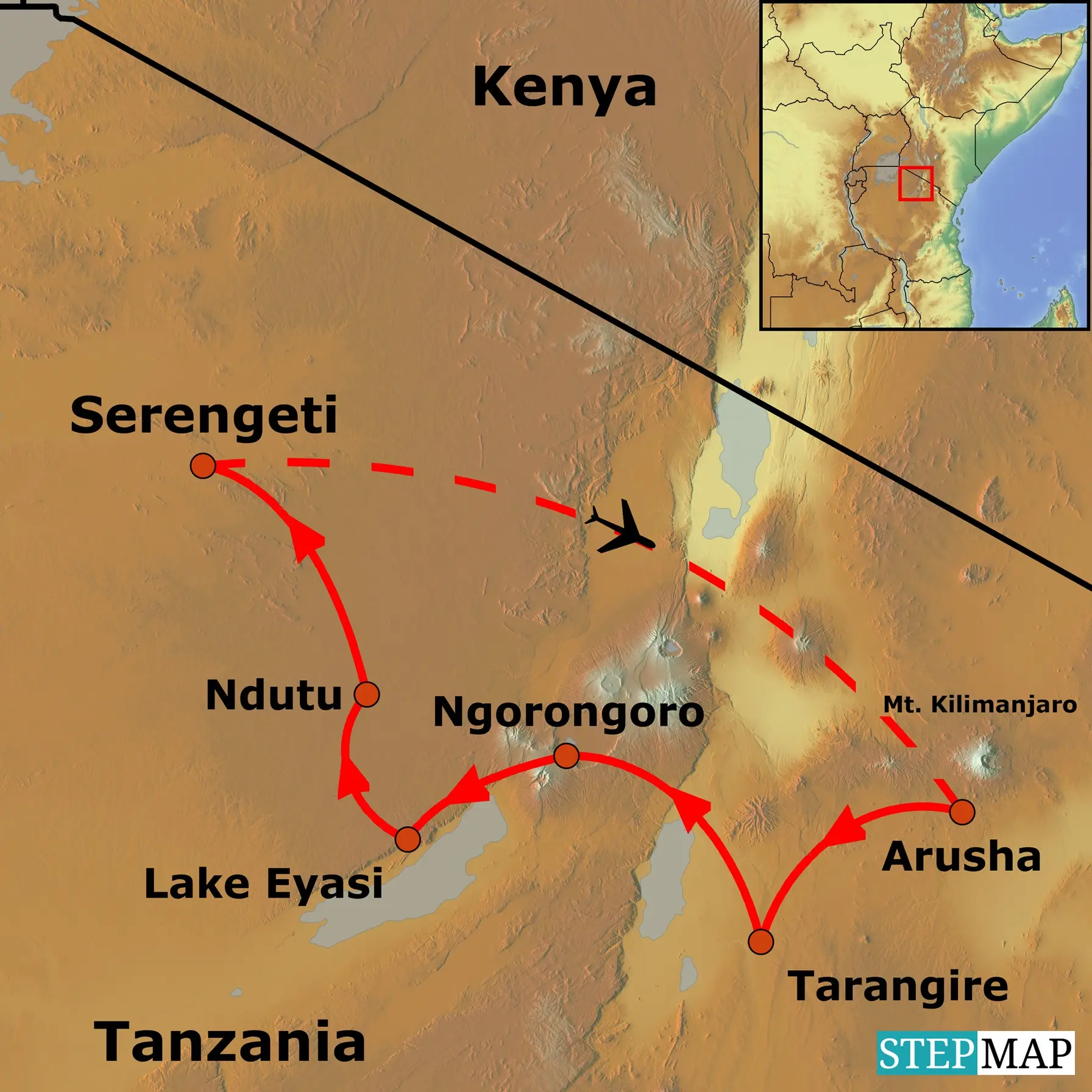
Itinerary & Map
Day 1 - Arusha
If you are arriving on Day 1, you will be collected from the airport and transferred to your lodge in the lush forests around the town of Arusha. Arusha is the safari capital of Tanzania located at the foot of Mt. Meru, close to Mount Kilimanjaro, the Manyara, Tarangire and Ngorongoro National Parks. Built by the Germans as a center of colonial administration because of the temperate climate, Arusha is the perfect location to begin an overland safari in northern Tanzania. You might consider an optional coffee plantation tour and tasting, to enjoy the fruits of the estate.
Tonight, we'll have a pre-trip orientation, followed by a group dinner in the lodge. Then it's off to bed, we start our safari adventure in the morning!
Day 2 - Arusha-Tarangire
Your safari begins after breakfast this morning. On our adventure we will be traveling overland crossing great swathes of the African plains and countryside, searching for the game herds and their ever-present predators.
We'll make our way towards Tarangire National Park, where open grasslands, acacia trees and the Tarangire River paint the wild landscape. Tarangire is one of Tanzania's richest reserves, known for its huge elephant population and baobab trees. It forms the center of the annual migratory cycle that includes up to 3000 elephant, 25,000 wildebeest and 30,000 zebras. Its high elephant population imparts a rare chance to get up close to these gentle giants, and there’s always the possibility of glimpsing some predators slinking through the savannah. A variety of ecosystems exist within the park boundary, providing a diverse range of wildlife with 94 species of mammals and over 500 bird species recorded.
In fact, after the Serengeti, Tarangire has the greatest concentration of wildlife in Tanzania and in the dry season the Tarangire River is a magnet for thirsty wildlife. Large herds of elephants and migratory wildebeest, zebra, buffalo, impala, gazelle, hartebeest and eland gather and not surprisingly the predators follow. This is also the one place in Tanzania where dry-country antelope such as oryx and gerenuk are regularly spotted. Tarangire is also known for its spectacular baobab trees, and its breathtaking views of the Maasai Steppe and the mountains to the south.
We'll spend the day in search of the animals, especially the large elephant population. Your trained guide shares exciting experiences and information about culture, fauna and flora as well as wild animals.
After our safari we'll find our way to our wilderness camp, where we'll spend the night in a luxury tented bush camp. If you’ve never experienced a luxury tent, you’re in for a true safari experience…with style! Tonight, we can enjoy drinks on the deck before sitting down to yet another outstanding African dinner. You’ll find the cuisine to be as impressive as the accommodations, too. Later tonight you might enjoy a drink under the stars, around the fire, as you review all of your stunning photos.
Day 3 - Ngorongoro
This morning after breakfast we'll leave Tarangire for a short drive northwest to the famed Ngorongoro Crater Conservation Area. This area includes the famous Crater and its lesser-known regions to the north; the Olduvai Gorge (where Lucy was found in 1974) and expansive plains of grassland which run all the way across to the Serengeti. Local Maasai herd their cattle and goats alongside Africa's famed wildlife, as they have for centuries.
Ngorongoro itself is the world's largest inactive and intact volcanic crater, which was formed three million years ago. We’ll embark on a spectacular drive up the crater wall to the rim, then descend to the floor of the crater to spend the day exploring this magnificent wildlife sanctuary. Being one of the largest calderas in the world, 12.4 miles wide and almost 2,000 feet tall, with a variety of animals and vegetation, Ngorongoro Crater is one of Tanzania’s most stunning areas. The vegetation includes grasslands, swamps, forests, saltpans, as well as a freshwater lake and has been compared to Noah's Ark or the Garden of Eden. With 20,000 grazing mammals and the world’s largest concentration of predators, you will have no trouble finding lion, elephant, buffalo and many of the plain's herbivores such as wildebeest, Thomson's gazelle, zebra and reedbuck, as well as thousands of flamingo wading in the shallows of Lake Magadi, the soda lake on the floor of the crater. If you're lucky you'll have a black rhino sighting, which is an absolute rarity elsewhere in this country. Within the steep walls of the crater not only will you find considerable movement of animals, but you may well come across local Maasai tribesmen (who have grazing rights here), tending their cattle.
This afternoon, after a picnic lunch in the crater near the hippo pool, we leave the crater and drive up the winding caldera wall road and head toward our lodge in the nearby town at the base of the volcano.
Day 4 - Hadzabe and Datoga
Early morning we'll depart to Lake Eyasi for a cultural experience with the nomadic hunter-gatherer Hadzabe tribe and the semi-nomadic pastoralist Datoga tribe. The Hadzabe inhabit the shore of Lake Nyasi, and with an estimated population of fewer than 2,000 individuals, the Hadzabe are one of the last tribes to stay true to their tribal history and culture. The skills they will demonstrate are not a mere performance. The bushmen rely on these techniques to survive, and you’ll need to be very attentive and at times quiet, while they demonstrate their use of locally made weapons and even poisons in incapacitating the creatures on which they depend for survival.
Also in the Lake Eyasi area are the Nilotic-speaking Datoga tribe, who are predominantly semi-nomadic pastoralists grazing cattle, goats, and sheep. During your visit to their homesteads, you'll learn about their way of life, animal tracking, medicinal plants, and their skill with simple blacksmithing.
Tonight, we return to our comfortable lodge for dinner and relaxation.
Day 5 - Ndutu
Ndutu is situated in the northern part of the Ngorongoro Conservation Area within the magnificent Serengeti. Lake Ndutu forms a shallow basin where water accumulates from the nearby areas of slightly higher altitude. The water in the lake is extremely saline, too saline for human consumption, but Lake Ndutu becomes alive with animals during the migration because it is surrounded by the Ndutu woodlands and the Short Grass Plains, which provide ample cover and food. From November to May, vast migratory herds visit the Ndutu area and provide a feast for the resident predators. Huge numbers of migratory birds come to the plains to feed and to escape the cold European winter. The lakes attract flocks of flamingos and other water birds. Animal viewing is excellent everywhere, as the surrounding landscapes are covered in sweeping grasslands which provide the perfect habitat for the migratory route for hundreds of thousands of wildebeest, antelope and zebra. Other commonly spotted species include leopard, lion, cheetah, caracal, serval, African wildcat, and a variety of prolific birdlife.
This morning after breakfast we'll head out in our safari vehicles to explore the rich ecosystem of the area. We'll follow the migrations paths to the Southern Serengeti corridor where each year, around the same time, the circular great wildebeest migration begins in the Ngorongoro Conservation Area of the southern Serengeti in Tanzania.
If time permits, we’ll stop and visit one of the remote Maasai villages along our route. Tall and thin, these semi-nomadic tribesmen are easily spotted by their brilliant red capes and easy-going demeanor. Their villages are surrounded by a large enclosure of thorny branches to protect their cattle, which make up their primary source of food, and are viewed as their wealth. The Maasai’s entire way of life truly revolves around their cattle. Interacting with them is often one of the highlights of the day!
Tonight, we'll stay in a true mobile tented camp in the Ndutu-South Serengeti area, our base of operations for the next two nights. The stunning display of stars tonight combined with the sounds of the wilderness will be an experience you won't soon forget.
Day 6 - Ndutu
Today we head out from our camp, to spend another day exploring the Ndutu-Serengeti wilderness, hoping to intercept some of the migration. This migration is a natural phenomenon determined by the availability of grazing. This phase lasts from approximately January to March, when the calving season begins – a time when there is plenty of rain-ripened grass available for the 260,000 zebra that precede 1.7 million wildebeest and the following hundreds of thousands of other plains game, including around 470,000 gazelles. Danger is everywhere for these animals as packs of lion, cheetahs and other carnivores are roaming throughout the area, waiting for the right moment to strike. The scenes are amazing!
Day 7 - Serengeti
Today we'll immerse one more time into a full safari adventure, spotting lions and leopards and in this area as well as relatively easy-to-sight cheetahs, especially where there are large amounts of prey such as gazelle. Our game drive will lead us into the central Seronera region of the Serengeti National Park, which sprawls across 5,757 square miles, and is Tanzania’s largest and most famous national park. Most of the park is open swathes of grassland, broken by isolated granite kopjes (hills) and patches of acacia woodlands. Famous for its cheetah, Cape buffalo, and large herds of giraffe, the chief herbivore of Serengeti is the wildebeest of which there are up to two million. The amazing annual migration of wildebeest herds is one of the biggest attractions of the Serengeti. It begins November at the northern end of the Serengeti National Park near the Kenyan border, when huge herds of these animals cross into Tanzania from the Maasai Mara area in Kenya to head for greener pastures in the South Serengeti and Ndutu. By December they've arrived and begin feeding on the lush short-grass plains. Now the zebras reach their peak of foaling, and the wildebeest and gazelle also give birth to their young. It's a predator haven with an abundance of game animals seen nowhere else on earth. We’ll have a box lunch today to allow us to stay moving through the stunning landscape of endless plains, dotted with animal herds.
Tonight, will find us at a different mobile tented bush camp, in yet another remote area of the Serengeti…enjoying a hearty dinner and a campfire. The evening ends listening to the sounds of the wild, watching the sun go down and gazing at the never-ending sky.
Day 8 - Seronera
This morning we’ll enjoy a short game drive in the morning as we make our way to the small Serengeti Seronera airstrip for our flight back to Kilimanjaro International Airport (JRO). Depending on the flight times, by late morning or early afternoon your flight will be landing, in plenty of time to catch your flight home, which typically depart in the evening.
Camps and Lodges
Due to availability at the time of booking, camps and lodges listed may change to similar properties
Arusha - Moivaro coffee lodge
At Moivaro Coffee Plantation Lodge you will find a charming atmosphere and enjoy every comfort you need to prepare for your bush safari. Moivaro Lodge is situated right in the heart of beautiful, natural scenery whilst only being 7 km from the town of Arusha: an ideal spot to enjoy the impressive flora and fauna of East Africa. At Moivaro Lodge they will ensure that you are able to relax in the unique location, before embarking on a safari.
Their spacious thatched brick cottages are set in a lovely tropical garden, with private verandas to guarantee every visitor all the privacy needed. Relax and enjoy the beautiful vista of Mount Meru from the comfortable veranda, go for a stroll around the Moivaro property walking trail, or laze at the pool nestling in the midst of tropical trees and coffee plants.
Tarangire - 5 Star Mbali Mbali Tented Camp
If you are looking for an authentic safari experience under traditional canvas showcasing spacious views and enriching culture, Mbali Mbali Tarangire River Camp is the perfect choice. Set within a 25,000-hectare concession area, Mbali Mbali Tarangire River Camp is located 3.5 km from the main entrance of the Tarangire National Park, overlooking a branch of the Tarangire River itself. Traditional grass thatching adorns the roof of the main lodge structure, which is set off the ground on an elevated deck. The breezy lounge boasts ample seating in a relaxing open-air environment. The dining area, where culturally inspiring meals are served, consists of simple safari style seating and the elevated position allows for excellent views over the riverbank below. Both the dining and lounge areas are married into a proper bon-fire area and game viewing deck that also overlook the same stunning views. The lodge’s small, informal gift shop offers the families of the nearby Maasai villages a chance to sell some of their handmade wares. All safari tents are equipped with private verandahs and en-suite bathrooms with toilet, shower and basin. Each safari tent has been built on an elevated wooden platform allowing for the movement of wildlife through the lodge and hence decreasing the interference of the lodge presence on the ecosystem. Thatched roofs keep the tents cool even at midday.
Ngorongoro - Ngorongoro Farm house
Hand plaited thatched roof tops, ample verandas and colonial interiors at Ngorongoro Farm House, a small and exclusive lodge built on a 500-acre coffee plantation, all of which has been designed to take you to the comfort and style of past times. Take a walk around the farm to contemplate the daily activities, relax in the fragrant gardens or enjoy the spectacular sunsets with the Oldeani volcano as a backcloth. A wonderful stop-off during a safari on the north circuit of Tanzania and a privileged place from where one can visit the crater or enjoy activities such a walking safari to the volcano or excursions to Lake Eyasi on the Rift Valley still inhabited by the Hadzabe tribe.
Ndutu-South Serengeti - Tanzania Ndutu mobile Bush Camp
This is a semi-permanent campsite, which combines the comfort of a stable structure and the practicality of mobile camping. In fact, the site can be moved seasonally according to the number of animals present, to the rains, and other natural surrounding elements. Situated in the famed Big Marsh area of Ndutu, known for its concentration of big cats during the migration, the location is the perfect spot to enjoy the migration from December to April. The camp enables the guest to experience an authentic African safari and at the same time offering the perfect balance between comfort, intimacy and splendid isolation. The camp is tucked away in the bush, shaded by acacia trees, and is furnished in safari style with simple ensuite bathrooms, it's ecofriendly as it runs on solar lighting, and consists of double spacious fully furnished tents. The camp completes its facilities with a mess tent where meals are served and a lounge tent. Here is the perfect base for you to indulge your passion for animal viewing and wildlife photography without missing out on your creature comforts. Apart from the massive presence of animals, the area has unforgettable and uncontaminated natural landscapes.
Central Serengeti - serengeti Sound of Nature Luxury Tented Camp
Nestled amidst the breathtaking landscapes of the world-renowned Serengeti National Park, our camp offers an extraordinary escape into the heart of Africa’s untamed beauty. From the moment you step foot into our camp, you will be transported into a realm where the wonders of the natural world come alive.
Immerse in the Wild, Embrace the Luxury
At Serengeti Sound of Nature Luxury Tented Camp, we have seamlessly blended the authentic safari experience with luxurious comfort. Our thoughtfully designed luxury tents provide an intimate setting, allowing you to feel the immediacy of the surrounding landscape while being cocooned in elegance. Wake up to the sounds of the wilderness, and as the sun sets, bask under the African night sky in the lap of indulgence.
An original form of accommodation which resembles the old camps of the first explorers in Africa, but with some modern amenities.
Image Gallery
Safari in East Africa and the Serengeti
Click the thumbnail to view larger image.
What's Included
What´s Included
- 1-night accommodation at Moivaro Coffee Lodge (or similar)
- 1-night accommodation at Mbali Mbali Tented Camp (or similar)
- 2 nights accommodation at Ngorongoro Farm House Lodge (or similar)
- 2-night accommodation at Ndutu Kati Kati Migration Tented Camp (or similar)
- 1-night accommodation at Serengeti Kati Kati Migration Tented Camp (or similar)
- All meals
- Arrival airport transfers from Kilimanjaro International Airport (JRO)...Tour begins on Day 1 at Moivaro Coffee Lodge near Arusha, and ends with the flight from Serengeti Seronera to JRO on Day 8
- All transfers during the tour, we use custom 4x4 overland safari vehicles. Size of vehicles is determined by group size. Every person has a window seat!
- Visits to Hadzabe, Datoga and Maasai tribes
- Game drives in Tarangire National Park, Ngorongoro Conservation Area, Lake Ndutu Wildlife Area, and Serengeti National Park. We normally have about two game drives per day, depending on weather and logistics. Wild animal encounters are also common in and around many of our camps and lodges.
- Fully escorted by a local ranger-guides in each vehicle.
What´s not Included
- International airfare
- Alcoholic drinks
- Items of a personal nature...laundry, telephone calls, etc.
- Early arrival package (accommodations, local tours).
- Gratuities to guides, drivers, or lodge staff
- Due to the remote nature of safari travel, Travel and Evacuation insurance is required for travel to Africa. Our office will email a quote to you when your initial deposit is processed.
- Visa fees, if necessary. A visa ($100) is required for U.S. visitors to Tanzania. It’s a fairly simple procedure, done at the airport upon arrival, or online in advance.
- Domestic flight from Seronera airstrip in Serengeti National Park to Kilimanjaro International airport on Day 8. Current price is $465. This is not included in your tour price, but will be billed when booked, or on your interim invoice.
- All National Park Fees, total of current fees are $810 per person, (subject to change). These are not included in the tour price but will be billed on your interim invoice.
what our Travelers are saying...